
Six steps to succeed with your ServiceNow implementation
Your company wants to adopt ServiceNow, but are you concerned about the business impact? Are you planning to implement a project and want to ensure...
 Sławek
•
6 min read
•
Sławek
•
6 min read
•
In today’s dynamic business environment, even organizations that have embraced Agile at the team level often struggle to achieve company-wide agility. The Scaled Agile Framework (SAFe) was designed to address this gap. SAFe is widely regarded as a leading framework for business agility, integrating the power of Lean, Agile, DevOps, and Systems Thinking (“Business Owners” 2025). In practical terms, it enables faster delivery of value, more predictable outcomes, and higher quality products – all essential for staying competitive. SAFe’s importance is underscored by its adoption across industries: 70% of Fortune 100 companies have SAFe-trained professionals on-site, and over a million practitioners have been trained in SAFe worldwide (“About”).
Agile methodologies (like Scrum and Kanban) revolutionized software development by prioritizing individuals and interactions, working software, customer collaboration, and responding to change over rigid processes. Adopting Agile leads to benefits such as reduced waste, quicker feedback loops, and a sharper focus on delivering customer value. It’s no surprise that Agile is mainstream today – over 80% of organizations use Agile practices in some form – as it systematically reduces losses from hand-offs and delays by keeping teams focused on incremental value delivery (“The C-Suite Guide to SAFe (Scaled Agile Framework)”).
Lean thinking, from which SAFe draws heavily, centers on eliminating waste and optimizing flow. It fosters an environment where individuals are valued while ensuring a continuous flow of value to customers with built-in quality in every increment. Continuous improvement of products and processes involves challenging the status quo and exploring better ways to deliver a better, more functional product (Lynn).
From DevOps, SAFe inherits a collaborative culture of shared responsibility, extensive automation, consistency, and repeatability. It emphasizes ongoing measurement to enable data-driven improvements and focuses on designing systems and processes that support quick recovery and learning from failures.
Finally, by applying Systems Thinking, SAFe treats both the solution and the enterprise itself as whole systems. It also seeks continuous improvement of the entire value stream – optimizing the whole (end-to-end) value delivery rather than local parts in isolation
|
SAFe |
Lean |
Agile |
DevOps |
Systems Thinking |
|
Respect for People and Culture |
✔ |
|||
|
Deliver incremental value |
✔ |
|||
|
Eliminating waste |
✔ |
|||
|
Encourages Innovation |
✔ |
|||
|
Continuous improvement |
✔ |
|||
|
People-centric collaboration |
✔ |
|||
|
Delivering working, high-quality software |
✔ |
|||
|
Customer Collaboration |
✔ |
|||
|
Responding to Change |
✔ |
|||
|
Culture |
✔ |
|||
|
Automation |
✔ |
|||
|
Continuous Measurement |
✔ |
|||
|
Resiliency on failure |
✔ |
|||
|
Solution as a whole system |
✔ |
|||
|
Enterprise as a whole system |
✔ |
|||
|
Continuous improvement of entire value stream |
✔ |
SAFe blends Agile’s speed and adaptability at the team level with Lean’s enterprise-wide efficiency and emphasis on waste reduction. These outcomes are enabled through a holistic approach rooted in Systems Thinking and reinforced by a highly collaborative DevOps culture, where solutions are continuously automated, monitored, and improved.
As a result we get a framework that encourages cross-functional collaboration, continuous improvement, and a focus on delivering the right things at the right time. This synthesis of Agile and Lean (along with influences from systems thinking and DevOps) makes SAFe a powerful catalyst for enterprise agility (“Core Values”). It is also industry-neutral – whether in finance, healthcare, software, or even government, the principles of delivering value quickly and eliminating inefficiencies apply universally.
How do you know when your organization’s Agile practice needs the boost of scaling? One common sign is when multiple Agile teams deliver individually, but the overall output still falls short of strategic goals. Perhaps products are still late to market, or priorities conflict across teams. You might notice excessive dependence on coordination meetings or frequent misalignment between business strategy and what teams are building. In short, if agility at the team level isn’t translating into agility at the enterprise level, it’s time to consider SAFe. Certain KPIs can highlight these gaps. For example, if cycle times are growing as your organization grows, or if the lead time from idea to deployment spans many months despite teams sprinting, it suggests a scaling problem. Low employee engagement scores can also signal that teams feel disconnected from the larger purpose. SAFe tackles these issues by introducing structure and alignment for multi-team Agile efforts. It promotes alignment, collaboration, and consistent delivery across large numbers of teams (“Scaled Agile Framework (SAFe) Values & Principles”). Concretely, organizations switching to SAFe have reported strong improvements such as 20–50% boosts in productivity, 25 - 75% improvements in quality, 30–75% faster time-to-market, and significant gains in quality and employee satisfaction (“About”). These outcomes underscore the main benefits of switching to SAFe:
Enterprise-wide Alignment: SAFe provides mechanisms (like common planning cadences or Enterprise Portfolio Management) to ensure everyone from executives to teams shares a single vision and priorities. This alignment means all teams are pulling in the same direction, dramatically reducing misalignment waste (“Enterprise”). When everyone is aligned, value delivery becomes much smoother and strategic goals are met more reliably (“Core Values”).
Faster Value Delivery: Through Program Increments and Agile Release Trains, SAFe creates a well-defined rhythm for delivering integrated solutions. By coordinating the work of many teams, SAFe accelerates delivery to customers (“About”).
Transparency and Visibility: At scale, problems can hide between teams or levels. SAFe’s emphasis on transparency surfaces issues early. For instance, PI Planning and system demos force visibility of all current work and any bottlenecks. SAFe’s built-in metrics and synchronization points create an open environment where teams can see what’s really going on and make decisions based on data, not guesses (“Core Values”) (“ServiceNow and Scaled Agile Framework (SAFe) for Business Growth”). This transparency builds trust and enables data-driven decision making.
Predictability and Quality: By organizing work into fixed cadence intervals (like 2-week sprints and quarterly PIs) and incorporating built-in quality practices, SAFe improves reliability. Organizations find they can meet commitments more consistently and maintain high standards of quality even as they move faster (“About”). In regulated or high-stakes industries, this predictability is a major selling point for SAFe. (“Built-In Quality”)
Cross-Team Collaboration: SAFe introduces roles and events that break down silos. When your Agile teams need better collaboration with other departments – say, Marketing or Compliance – SAFe’s structure facilitates it. The framework explicitly involves Business Owners and other stakeholders during PI Planning, so business and technology stay in lockstep (“Business Owners”).
SAFe defines up to four levels of organization and planning: Team, Program, Solution and Portfolio and four different configurations: Essential SAFe, Large Solution SAFe, Portfolio SAFe, and Full SAFe. These configurations essentially differ in the type and number of layers above the Program level; Essential SAFe (the simplest configuration) includes the Team and Program levels, while the Large Solution and Portfolio levels are additional layers used in the remaining larger-scale configurations.
|
Essential SAFe |
Large Solution SAFe |
Portfolio SAFe |
Full SAFe |
|
|
Team |
✔ |
✔ |
✔ |
✔ |
|
Program |
✔ |
✔ |
✔ |
✔ |
|
Large Solution |
✔ |
✔ |
||
|
Portfolio |
✔ |
✔ |
Implementing SAFe in an enterprise is a collaborative effort involving individuals across various roles - from executives to coaches to team leads. SAFe emphasizes the concept of Lean-Agile Leadership: leaders at all levels are expected to lead by example in understanding and espousing Lean-Agile principles (Piikkila) (Sinek). Managers and executives have to adopt a new mindset (decentralized decision-making, servant leadership, continuous learning) - identifying and enabling those leaders is an important part of SAFe transformation.
ServiceNow’s Agile Development 2.0 application is a tool for Scrum/Kanban team management using backlogs, sprints, epics, user stories & Visual Task Boards (All Menu > System Definition > Plugins).
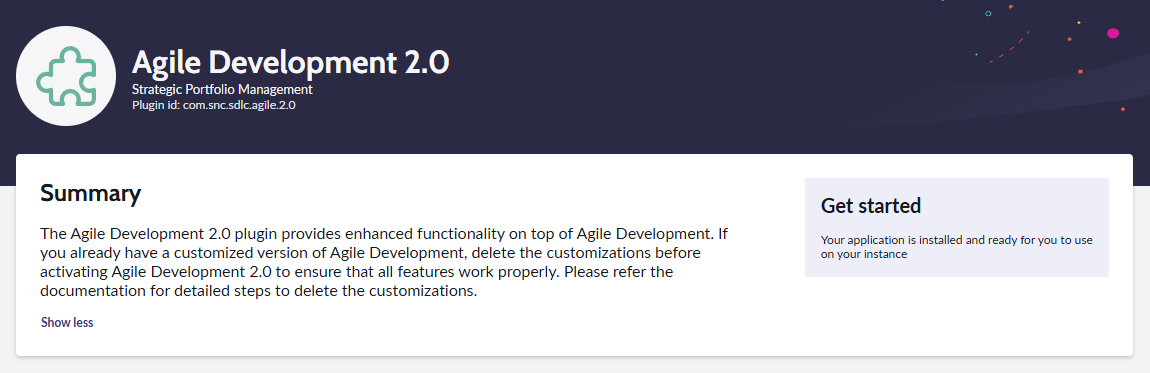
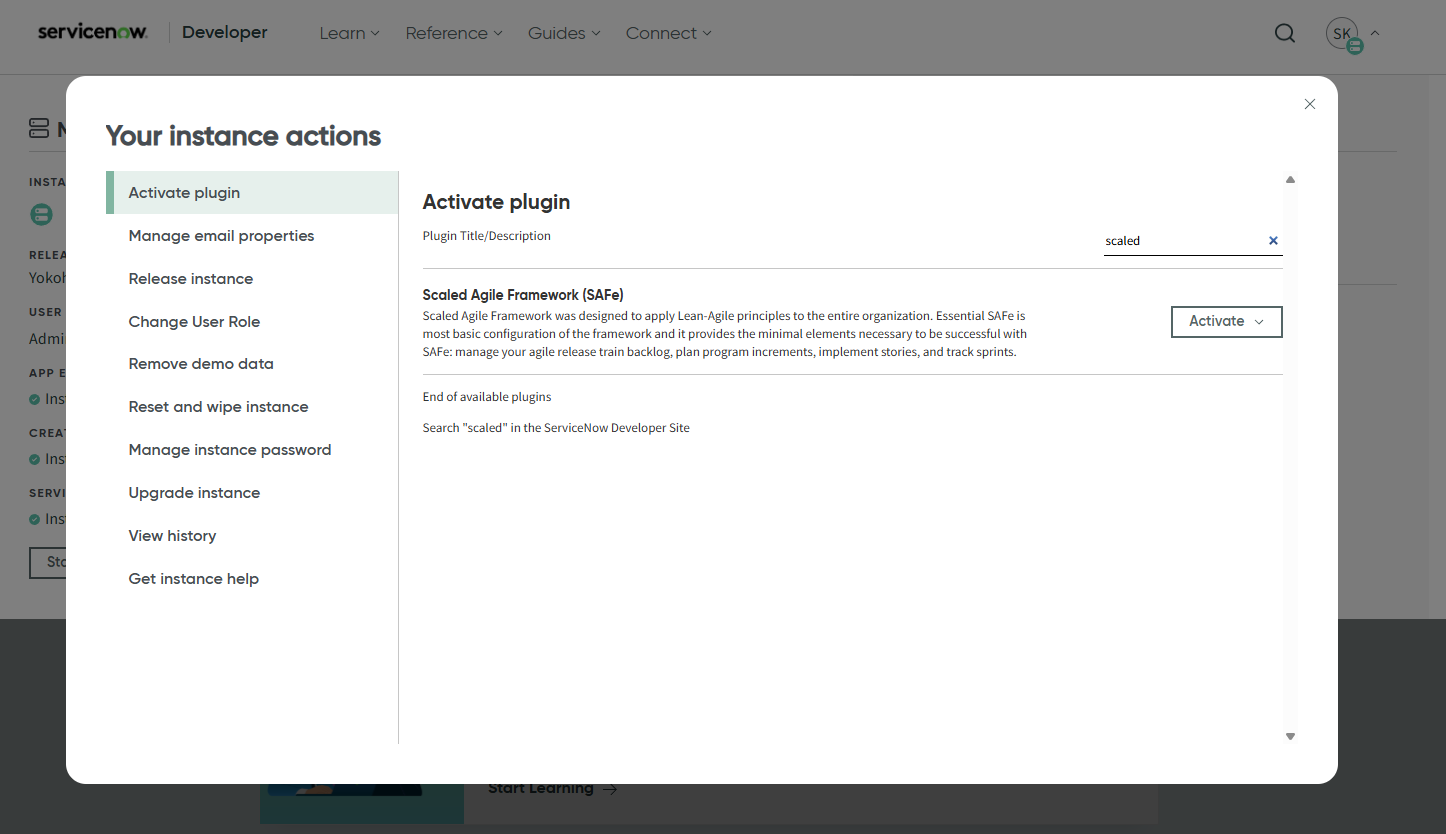
It can be extended with the SAFe extension (Scaled Agile Framework plugin). You can safely try out the Scaled Agile Framework plugin on a PDI by enabling the plugin (Developer Portal > User Menu > Activate Plugin > Scaled Agile Framework (SAFe).
ServiceNow provides a SAFe module that introduces new record types corresponding to SAFe concepts (like Program Increments, Features, etc.). A common worry is: “Do we lose all our existing epics, themes, and user stories when switching on the SAFe module?” The answer is no – you don’t lose them. Scaled Agile Framework plugin is designed to build on Agile 2.0, not replace it entirely. SAFe entities correspond to elements of the latter and allow the framework to be scaled for large enterprises.
|
Agile Development 2.0 |
Scaled Agile Framework (SAFe) |
|
User Story |
User Story |
|
Epic |
Feature |
|
Theme |
Strategic Theme or Epic at the portfolio level |
|
Sprint |
Program Increment |
SAFe team is an autonomous, cross-functional team containing members possessing different skill-sets who work in collaboration to achieve a common goal. Agile Release Train (ART) comprises a set of teams working towards a single solution. Teams within an ART collaborate and produce to achieve the agreed-upon goals within a set time period called program increment - it is similar to a sprint in Agile and typically spans over 8–12 weeks. Epic in SAFe is the largest unit of work, which can be continuously worked through multiple program increments. An epic is further decomposed into features for implementation and delivery by SAFe ARTs. A SAFe feature is an equivalent to the epic in Agile Development. It must be small enough for completion within a program increment cycle. It is prioritized and sequenced in an ART backlog based on its global ranking. A feature is further decomposed into user stories for implementation and delivery by SAFe teams (“SAFe entities”). SAFe stories use the same work item type as Agile 2.0 stories. Importantly, your existing user stories remain intact; they are simply organized under features within a Program Increment (PI). Agile’s notion of Themes (a higher-level categorization for epics) is comparable to SAFe Strategic Themes, which are more about strategy alignment than a container of epics, or SAFe Epics - both at the portfolio level.
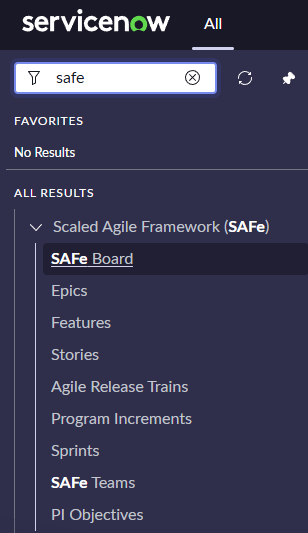
Once the SAFe plugin is enabled, you’ll see a new application menu in the ServiceNow navigator labeled “Scaled Agile Framework (SAFe)”.
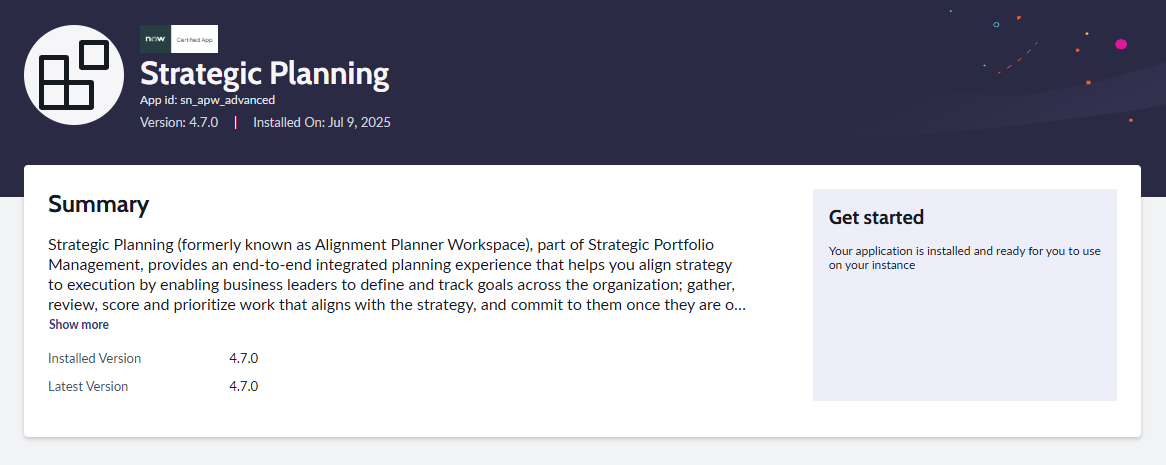
ServiceNow is continually evolving its Agile solution set. Recently, Enterprise Agile Planning was introduced within Strategic Planning App as an evolution of its agile management capabilities, which may eventually supersede the older SAFe plugin (All Menu > System Definition > Plugins).
Moving from team-level Agile to enterprise-scale agility is a journey - one that requires careful planning and change management. SAFe provides a map for that journey. It’s comprehensive and may seem too heavy, but also provides the flexibility to start small (for instance, implement Essential SAFe on one value stream, prove success, then expand). The strongest argument in favor of SAFe is that it directly addresses the problems that plague large organizations trying to be agile: the lack of alignment, the unclear priorities, the inter-team dependencies, the absence of customer focus at the top. SAFe tackles these head-on with a structured approach that still embodies the spirit of Agile – delivering value incrementally, empowering teams, and adjusting continually based on feedback. With these points, you can confidently make the case to “trigger your company’s transformation towards SAFe.”

Your company wants to adopt ServiceNow, but are you concerned about the business impact? Are you planning to implement a project and want to ensure...
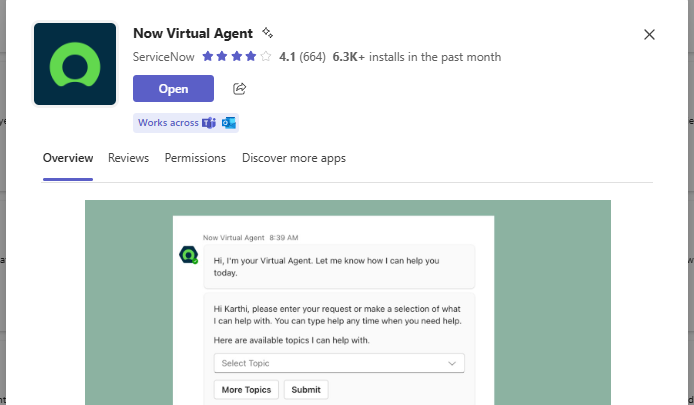
ServiceNow introduced integration capabilities with Microsoft Teams, allowing, e.g., the Virtual Agent to be used directly in Teams. This feature is...

Telecommunication Service Management: The Backbone of Modern Connectivity In today's digital age, the ability to communicate, share information, and...