
Three Forces Made CSDM Non-Optional
Autonomous AI, EU regulation, and ServiceNow's new commercial model have turned the Common Service Data Model (CSDM) from a hygiene project into the...
 Odd M. Leonhardsen
•
5 min read
•
Odd M. Leonhardsen
•
5 min read
•

For years, CSDM lived inside the CMDB conversation, and it was treated the way good infrastructure usually is: clearly important, easy to agree with, and easy to defer. What has changed is not that it finally matters. It is that its importance has become impossible to ignore.
I have been close to this problem for a long time. I worked with ITIL at IBM in the early 2000s, when the CMDB was still largely a theoretical construct, I was part of opening ServiceNow's first office in Norway in 2014-2015, and today, as VPSolutions at The Cloud People, I help organizations get real value from the platform. Where they invested in the service model, it paid off, in cleaner reporting, trustworthy impact analysis, and more reliable change. Where they deferred it, that was rarely a judgment that it did not matter, only that it could wait a little longer.
Agentic AI has changed that calculation. The same ownership, dependencies, lifecycle, and classification that fed a report are now the context an autonomous agent reads before it acts. The cost of an incomplete model is no longer absorbed quietly, over time, by people. It is paid immediately, at machine speed. The model is exactly as important as it always was. What changed is the reader.

01 – The reframing
I want to be careful with the argument, because it is easy to misread. CSDM has always been important. The organizations that invested in it earned cleaner reporting, trustworthy impact analysis, more reliable change, and a service view the business could actually act on. That value was real, and the teams who did the work were right to.
What was also true is that the payoff was indirect enough to keep losing the priority fight. A stronger service model rarely arrived with a deadline attached, so in many organizations it waited behind work with a more immediate return. Not because anyone decided it was unimportant, but because its importance was the kind you could safely postpone.
AI takes that comfort away. The same model that was valuable to a human reading a report is now the context an autonomous agent reads before it acts on the business. CSDM did not become important in 2026. It became impossible to defer, because its importance stopped being a matter of judgment and turned into a matter of consequence.
“CSDM did not start mattering now. It stopped being safe to postpone.”
02 – What AI reads
It helps to be precise about the difference between the CMDB and CSDM, because that distinction is the whole argument. The CMDB stores records: configuration items and their attributes. CSDM is the standard that turns those records into a service graph, what is a business service, which application supports it, who owns it, what it depends on, what state it is in, and how a change in one place propagates to another.
A human can work from raw records and assemble the graph from memory. An agent cannot. When ServiceNow's Context Engine grounds an agent's decision, it draws on the relationships, ownership, and lifecycle held in that graph. When an agentic specialist routes a task, assesses an impact, or takes an action, it traverses the same structure. The records are the raw material. The graph is the understanding. And the understanding is the part CSDM provides.
So the practical question is no longer "is our CMDB populated." It is "can an agent understand our business from what we have actually modelled." Those are different questions, and only the second one predicts how safely AI will behave once you switch it on.
“A populated CMDB tells you the data exists. Only the service model tells you the AI can understand it.”
03 – The provocation
Here is the part I would put in front of every executive. For years, impact analysis was something a human ran before a change, a report to read and weigh. With autonomous agents, impact analysis is no longer a report. It is a real-time safety control the agent itself relies on, and it is only ever as good as the dependency model beneath it.
A human change manager who meets a thin model slows down. They ask around, they wait for the window, they sense risk and hesitate. An agent does none of that. It reads the dependencies that are modelled, judges the impact to be contained because the rest is not mapped, and acts, correctly and quickly, on an incomplete picture.
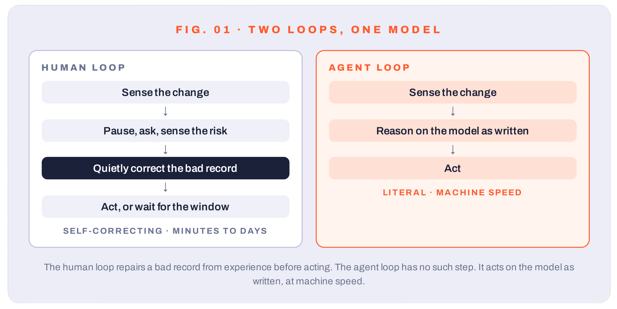
The danger is not that the agent is reckless. It is that the agent is precise about an incomplete model. It will act before the organization can recognize what it touched, because the dependencies that would have revealed the consequence were never in the graph. Speed without context does not produce caution, it produces confident, fast, wrong action.
04 – The bridge
This is where ServiceNow's own positioning makes the connection concrete, and saves me from having to argue it. ServiceNow describes AI Control Tower as the place to discover, observe, govern, secure, and measure every AI agent and model across the enterprise, and it states plainly that it does this on the only platform that connects AI strategy, governance, and security to your workflows and your CMDB.
ServiceNow's own headline for the tool is "you can't control what you can't see." That sentence is the entire CSDM argument, restated by the vendor. The control tower can observe and govern an agent's behaviour, but only against the model that describes the services, owners, and dependencies the agent is acting on. Where the model is blank, the tower has nothing to observe against, and governance becomes a dashboard over a gap.
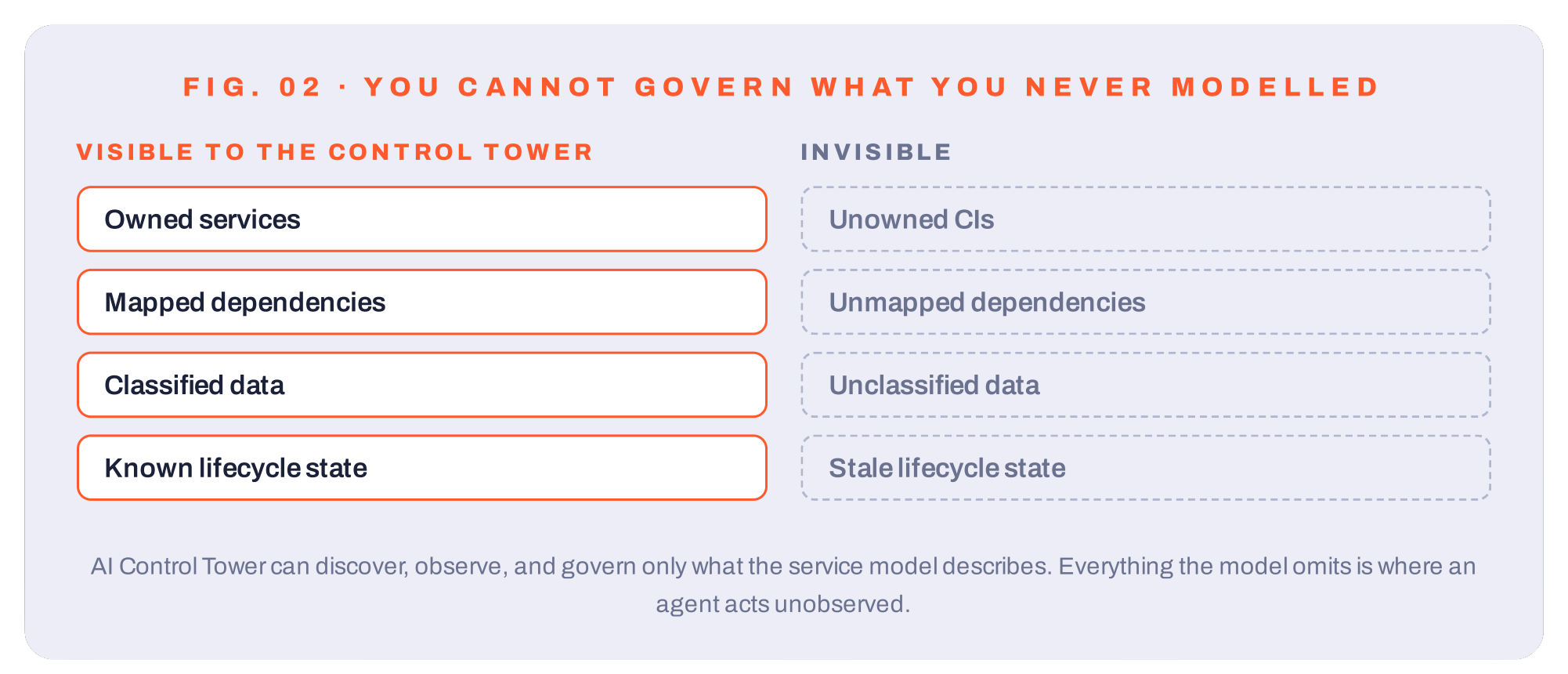
The shift to runtime governance makes this sharper. Governance used to be a review before launch: a model registry, a risk score, a committee meeting. That is too slow for agents that choose tools and act between human checkpoints. Runtime governance asks what an agent is doing right now, which service it is touching, which owner is accountable, what it depends on. Every one of those questions is answered from CSDM. AI governance is only as strong as the service model it sits on.
05 – The reframe
CSDM maturity is your AI readiness score
Once you accept the reframing, the way you run the work changes.You stop scoping CSDM as a database cleanup with no end date, and start scoping it as AI readiness, prioritized by where agents will act first. Three practical consequences follow.
Harden ownership, dependencies, and classification first on the services where you intend to let agents act, and where a wrong action would hurt most. Perfection everywhere is not the goal. Readiness where it matters is.
If an agent can act on a service, its dependencies must be modelled well enough for impact analysis to be trusted and for the Control Tower to observe what was touched. That is a precondition for switching the agent on, not a nice-to-have.
Let the pace of autonomy follow the maturity of the model, service by service. Where the graph is strong, let agents act. Where it is thin, keep a human in the loop until it is not.
Framed this way, your CSDM maturity is, quite literally, your AI readiness score. It is the ceiling on how much autonomy you can safely allow, and it is a number you can raise deliberately rather than discover by accident.
“Nothing you buy raises that ceiling. Only the model does.”
06 – Final reflection
It is tempting to treat AI readiness as something you purchase: a licence, a control tower, a fleet of agents. Those things matter, but they all sit on top of a layer no contract includes, the service model that tells the AI what your business actually is.
That layer is CSDM, and it is the one part of AI readiness you cannot buy, only build. It is also the part that has been waiting, half-finished, in many organizations for years, important all along but rarely urgent enough to win the priority fight.
The reframing is simple, and I think it is urgent. CSDM outgrew the CMDB conversation the moment the model's main reader stopped being human. It is now the difference between AI that acts with understanding and AI that acts without it, quickly, at scale, on whatever you happened to model. The organizations that win with AI over the next few years will not be the ones with the most agents. They will be the ones whose agents understand the business they are acting on.
“AI readiness is not the agents you deploy. It is the model they read before they act.”
Access the full brief as PDF by clicking here:
 THE PERSPECTIVE SERIES
This is a part of an ongoing series from The Cloud People on ServiceNow, enterprise platforms, and AI-driven transformation. More to follow.

Autonomous AI, EU regulation, and ServiceNow's new commercial model have turned the Common Service Data Model (CSDM) from a hygiene project into the...
ServiceNow has quietly become the AI platform for enterprise transformation. Most organizations still run it as a ticketing tool under IT...
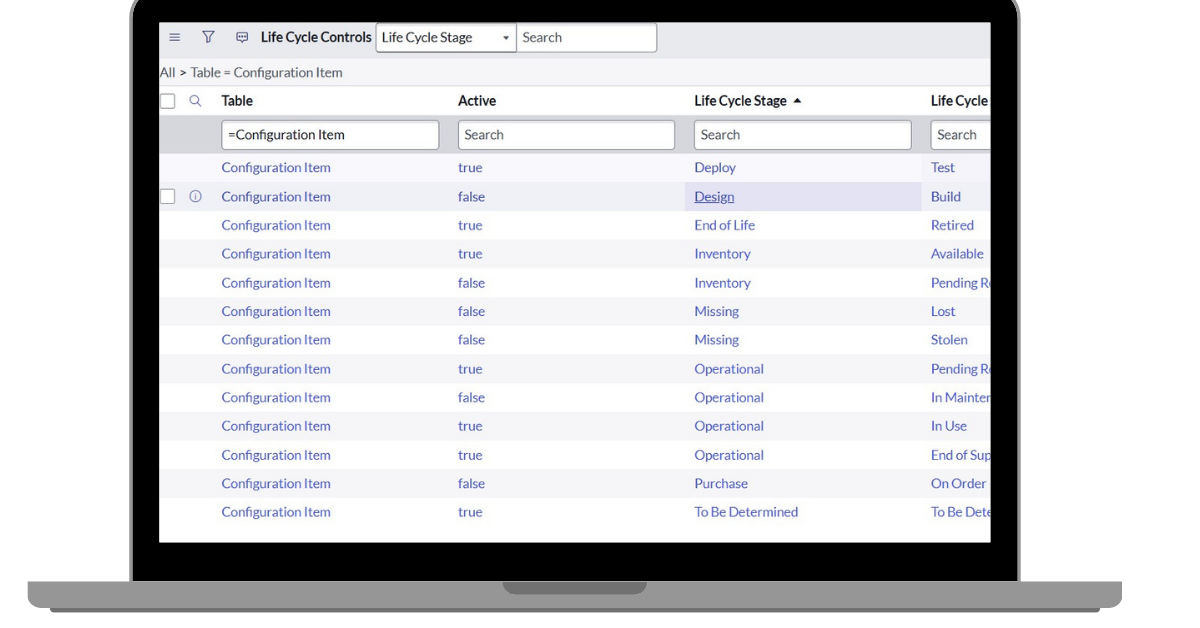
In CSDM (Common Service Data Model) version 4 ServiceNow introduced the so-called “Life Cycle fields” that are to replace all legacy status fields...