ServiceNow AI Control Tower: The Missing Piece Before You Scale AI on the Platform

ServiceNow AI Control Tower: The Missing Piece Before You Scale AI on the Platform
9:14

If you are a ServiceNow platform owner, chances are you have watched the AI conversation unfold from the sidelines for the past couple of years. Virtual Agent, Now Assist, Predictive Intelligence and, more recently, AI Agents and agentic workflows have all shown up in release notes, upsell conversations and Knowledge keynotes. You know the platform. You know what "governed" actually means in a ServiceNow context, because you have spent years building it into your ITSM, HR or CSM implementation. That is exactly why you have probably been cautious about AI: turning it on without the same discipline you apply to everything else on the platform feels like a step backward, not forward.

That caution is well founded. But it does not have to mean waiting indefinitely. ServiceNow's answer to "how do we adopt AI without losing control" is AI Control Tower, and if you are the person accountable for what happens on your instance, it is worth understanding before you greenlight your first wave of agents.

What AI Control Tower actually is

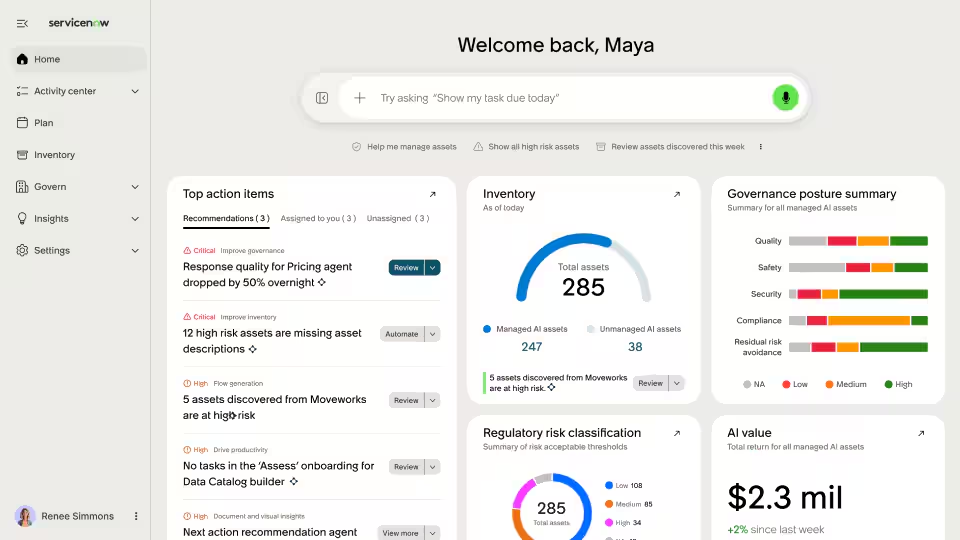
AI Control Tower is not an AI engine. It does not build models or agents itself. It is a governance and oversight layer on the ServiceNow AI Platform that gives you one place to see, manage and control the AI assets in your organization, whether they are ServiceNow-native (Now Assist skills, AI Agents built on the platform) or external (models and agents running in AWS, Azure or Google Cloud, or embedded in enterprise applications).

AI Control Tower was introduced at Knowledge 2025. At Knowledge 2026 in May, ServiceNow expanded it into an end-to-end solution organized around five dimensions:

  • Discover: finds AI assets across the organization, including systems beyond ServiceNow, through integrations with AWS, Microsoft Azure and Google Cloud and with enterprise applications such as SAP, Oracle and Workday. Discovered assets are brought into the same data model as the rest of your platform estate, with ownership and relationships.
  • Observe: continuous monitoring with live metrics and alerts, instead of periodic audits after the fact. Through ServiceNow's acquisition of Traceloop, this now extends to runtime observability of how agents reason and where they make decisions.
  • Govern: risk assessment across agents, models, datasets, prompts and classic machine learning, with risk frameworks aligned to NIST and the EU AI Act, tied into existing GRC processes so AI risk is not managed in a separate silo.
  • Secure: extends identity and access governance to AI: least-privilege access, visibility into what each agent can reach, and the ability to act when an agent operates outside its intended scope, including disabling it.
  • Measure: dashboards that connect AI activity to adoption, cost and business value, so value is visible rather than assumed.

In short: it is the inventory, guardrails and dashboard that let you treat AI as a managed part of your platform estate, the same way you already treat applications, integrations and workflows.

A note on versions and licensing. The expanded five-dimension scope ships with the Australia release. If you are in Yokohama or Zurich, core inventory and governance capabilities are available, but not everything described above. Some capabilities may also depend on your entitlements. Check what your release family and licensing include before you plan the rollout.

Why this matters for platform owners who have not gone all-in yet

If you have held back on AI, it is likely for one or more of these reasons, all of which AI Control Tower is built to address.

"I don't actually know what's already running." Between Now Assist trials, business units experimenting with third-party copilots and developers wiring up MCP servers, AI adoption often happens in pockets before a platform owner has visibility into it. By connecting AI Control Tower to your ServiceNow AI capabilities and to the cloud and application sources your organization uses, you build an inventory of that AI in the CMDB, where it belongs alongside everything else you are accountable for. The more sources you connect, the fewer blind spots remain.

"I can't govern what I can't see, and I won't open the floodgates without governance." This has been the core blocker for many platform owners. AI feels different to govern than a workflow or an integration, because its behavior is not fully deterministic. AI Control Tower gives you the kind of control you already expect elsewhere on the platform, such as policy enforcement, access scoping and the ability to stop an agent, applied specifically to AI.

"I have no way to prove value, so I can't justify expansion." Even where AI has been switched on, many platform owners struggle to show what it delivers, which makes it hard to argue for going beyond a pilot. The Measure dimension ties adoption and cost to outcomes, turning "we think it's helping" into something you can defend in a budget conversation.

"My organization's AI footprint is bigger than ServiceNow." Platform owners are increasingly the point of contact when leadership asks "what AI do we have, anywhere?" With integrations into the major hyperscalers and enterprise applications, AI Control Tower lets you answer that question from one place instead of stitching together answers from five different teams.

Where the value shows up for existing customers

For an organization that has already invested in ServiceNow, the value of AI Control Tower compounds on what you already have:

  • It uses the CMDB you have already built. AI assets become records with real relationships to business services, extending a data model your organization already trusts rather than introducing a parallel governance tool with its own inventory.
  • It plugs into the GRC you already run. If you have built risk and compliance workflows on the platform, AI risk becomes another managed category in that process rather than a bolt-on exception.
  • It turns AI adoption into a staged, defensible rollout. Instead of an all-or-nothing decision, you install AI Control Tower, define governance roles and expand deliberately, with visibility and audit trails at every stage.
  • It protects the platform's reputation for reliability. ServiceNow is valuable to your organization because it is trusted as a system of record and system of action. Ungoverned AI is the fastest way to erode that trust. AI Control Tower lets you extend AI capability without extending risk.
  • It gives you a business case, not just a technical one. Value dashboards let you walk into a steering committee with cost and value data instead of anecdotes, which is usually the real blocker to scaling AI beyond a proof of concept.

What we see in practice

Working with AI Control Tower alongside ServiceNow customers, a few patterns keep coming up.

  • Installing is the easy part. The technical setup is manageable. Agreeing who owns what, who the AI stewards are and who can approve a new use case takes longer and matters more. Start that conversation early.
  • The first inventory is a starting point, not a final answer. Begin with Now Assist and your most important cloud platform, get value from that, and add sources over time. Waiting for complete coverage before acting is a way of never starting.
  • Value has to be defined before it can be measured. Agree on the baseline and the outcomes you care about up front. Dashboards show data; they do not decide what success looks like.

The practical starting point

You do not need a fully formed AI strategy to start. A reasonable first step looks like this:

  1. Confirm entitlement and install AI Control Tower from the ServiceNow Store, including its dependent plugins. Availability depends on your licensing and release family.
  2. Assign governance roles first, such as AI steward and AI asset owners, so accountability exists before anything is discovered or approved.
  3. Connect the sources that matter: sync your Now Assist skills and activate AI Discovery for the hyperscaler and external AI platforms you use, to build an inventory of the AI already touching your environment.
  4. Use that inventory to make an informed, staged decision about where Now Assist or AI Agents make sense, with guardrails in place from the start rather than retrofitted later.

How The Cloud People can help

The Cloud People offers a standard AI Control Tower Proof of Value: a fixed-scope, fixed-price engagement that puts AI Control Tower to work on your own instance, gets governance roles and a first inventory in place, and leaves you with a concrete basis for deciding how to scale AI on the platform.

For a platform owner, the appeal is not AI for its own sake. It is that AI Control Tower lets you apply the same rigor to AI that you already apply to everything else you are responsible for. That has arguably been the missing piece holding cautious, well-run ServiceNow organizations back, and it is now a product rather than a gap you have to solve yourself.

Want to see what AI Control Tower would find on your platform?

Get in touch with The Cloud People to talk about a Proof of Value.

Related blog posts

The AI you've bought may be illegal to deploy

The AI you've bought may be illegal to deploy

The situation More tim e , less m a rgin. On 7 May 2026, EU negotiators reached a provisional agreement — the Digital Omnibus on AI — to postpone...

EU AI Act Readiness for ServiceNow users

EU AI Act Readiness for ServiceNow users

Your AI is already moving into the workflow. Is your governance keeping up? AI is quickly becoming part of how work gets done. In ServiceNow, it can...
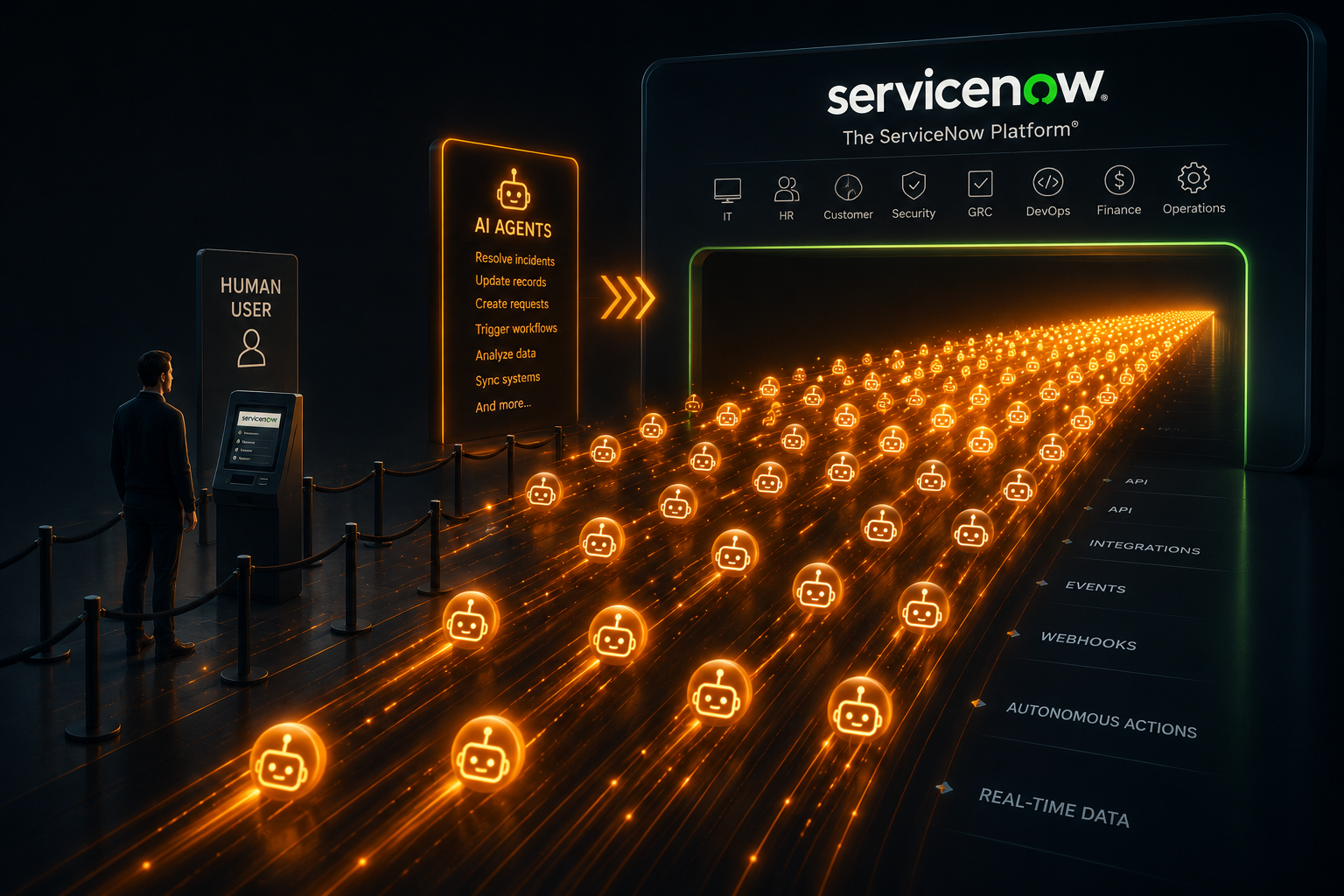
Your platform’s next user is not a person

Your platform’s next user is not a person

At Knowledge 2026, ServiceNow opened its full system of action to any AI agent, headlessly, through a generally available MCPServer. Twenty years of...