From Governance to Compliance: How AI Control Tower Gets You Ready for the EU AI Act

From Governance to Compliance: How AI Control Tower Gets You Ready for the EU AI Act
7:51

In our previous post, we looked at what ServiceNow AI Control Tower is and why platform owners who've been cautious about AI adoption should take it seriously. We framed the case mostly in platform terms: visibility, guardrails, and the ability to expand AI use with the same discipline you already apply to everything else on the Now Platform.

Read the article EU AI-Act-readiness for ServicenNow-platform owners

There's a second, more urgent reason to get this in place now, and it has a deadline attached to it: the EU AI Act.

The regulation turns many of the principles behind good AI governance — visibility, risk management, traceability, and human oversight — into concrete compliance requirements. And unlike governance work that platform owners can build gradually over time, the AI Act comes with specific dates, documentation requirements, and potential penalties.

This post looks at what's actually required, and how AI Control Tower maps onto it.

The current state of the Act, in plain terms

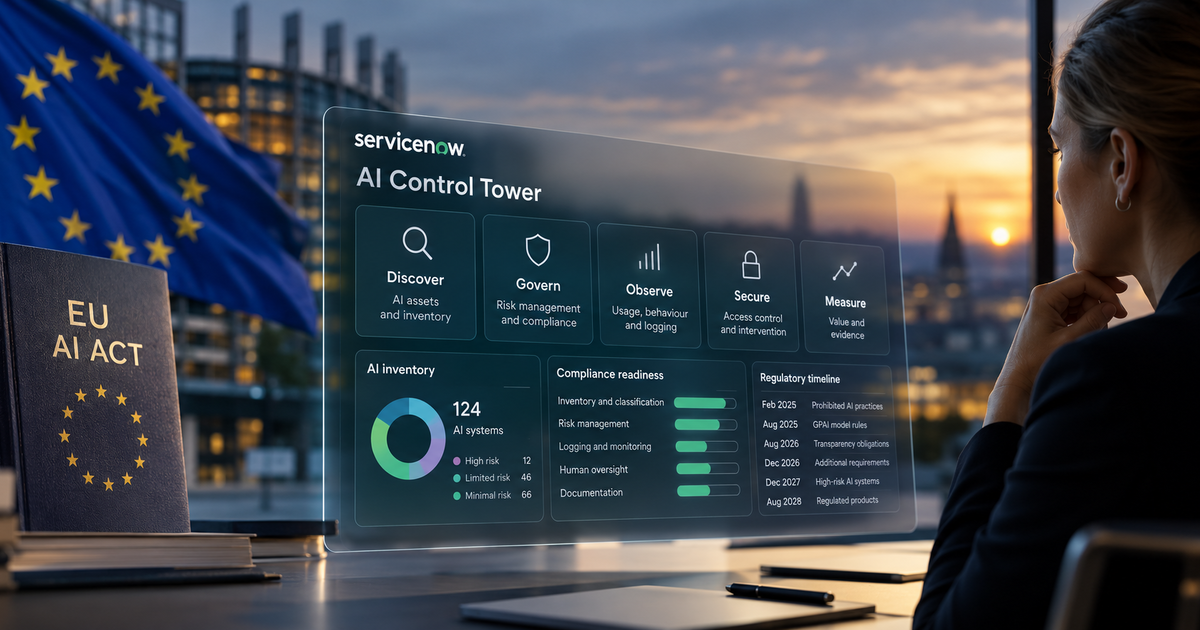
The EU AI Act has been rolling out in phases since it entered into force in August 2024, and the timeline shifted meaningfully in 2026. A Digital Omnibus regulation was adopted and is now in force, which pushed back some of the heavier high-risk deadlines, but did not remove the obligations, and several dates are already active or fast approaching:

  • Since February 2025: Prohibited AI practices (social scoring, manipulative AI targeting vulnerable groups, most real-time biometric surveillance, workplace emotion recognition, and untargeted facial-recognition scraping) are banned outright.
  • Since August 2025: Rules for general-purpose AI (GPAI) models — documentation, training data summaries, copyright compliance — are in force for new models.
  • From August 2026: Article 50 transparency obligations apply — disclosing AI interaction, labeling synthetic content, and informing people when they're subject to emotion recognition or biometric categorization.
  • December 2026: New prohibited-practice categories take effect, alongside further transparency and content-marking requirements.
  • December 2027: The big one for most enterprise platform owners — Annex III standalone high-risk AI systems (used in employment decisions, access to essential services like credit, education, and similar sensitive domains) must meet full conformity requirements: risk management, data governance, technical documentation, logging, and human oversight.
  • August 2028: AI embedded in already-regulated products (medical devices, machinery, vehicles) reaches its own compliance deadline.

The practical takeaway for a platform owner: the later dates are transition milestones, not permission to wait. Classification, inventory, and documentation work needs to start well before your systems reach the compliance-heavy tiers, while some obligations are already in effect.

Why this becomes an operational platform question

The legal and compliance teams will naturally play a central role in interpreting the EU AI Act. But meeting its requirements depends on capabilities that have to work operationally.

Organizations need an inventory of the AI systems they use, with ownership and risk classification. They need ongoing risk management, operational logging, human oversight, and records that can help explain AI-influenced decisions.

Those requirements depend on systems, workflows, and data — not just policies.

For ServiceNow customers, much of that operational infrastructure already exists on the Now Platform. The question is how to extend it to AI.

Mapping AI Control Tower to the Act, pillar by pillar

This is where the five capabilities we introduced in the last post stop being a nice-to-have and start being the mechanism for putting those governance requirements into practice.

Discover → Inventory and classification. You cannot classify what you don't know exists. AI Control Tower's automatic discovery of every AI agent, model, and MCP server — native to ServiceNow or running in AWS, Azure, Google Cloud, or third-party enterprise apps — gives you the starting inventory the Act requires. Because each asset lands in the CMDB as a configuration item with lineage and ownership, you have a defensible, audit-ready record of what you have and who's accountable for it, rather than a manually maintained list that's out of date the day it's finished.

Govern → Risk management and documentation. The Act requires a risk management system maintained throughout an AI system's lifecycle, not a point-in-time assessment. AI Control Tower's governance layer applies consistent policy across every AI asset and ties into GRC workflows you likely already run on the platform — meaning AI risk becomes a tracked, ongoing category inside a process your organization already trusts, rather than a separate compliance exercise that falls out of date.

Observe → Logging and human oversight. The Act's requirement for automatic operational logging and genuine human oversight maps directly to AI Control Tower's runtime observability — visibility into how an agent actually reasons and makes decisions, not just whether it ran. This is also where you build the evidence base for Article 86: if someone asks why an AI system made a decision that affected them, you need a record of what happened, not a reconstruction after the fact.

Secure → Access control and the kill switch. Human oversight isn't meaningful if there's no way to act on it. AI Control Tower's identity and access governance — least-privilege enforcement, exposure monitoring, and the ability to detect and shut down an agent operating outside its permitted scope in real time — is the operational teeth behind the Act's oversight requirement. When a regulator or auditor asks "what happens when an AI system misbehaves," this is your answer.

Measure → Evidence for the conversations that follow. Cost and ROI dashboards weren't built with the AI Act in mind, but they end up doing double duty: the same data discipline that lets you justify AI investment to a steering committee is the data discipline that lets you demonstrate ongoing, active management of an AI system to a regulator.

What this means for the "not yet all-in" platform owner

If you've been waiting for AI adoption on ServiceNow to feel more settled before expanding it, the AI Act actually strengthens the case for AI Control Tower now, rather than weakening it. You're not choosing between moving cautiously and staying compliant, a properly governed rollout is the compliant one.

Getting the inventory, classification, and oversight mechanisms in place before you scale AI use means:

  • You classify new AI use cases against the Act's risk tiers as you introduce them, rather than retrofitting classification onto a sprawling, undocumented estate years from now.

  • You build the audit trail and human-oversight habits into your operating model from day one, instead of trying to reconstruct them under deadline pressure.

You can speak to your organization's AI risk posture — inside ServiceNow and beyond it — from a single source of truth, which matters as much for your own leadership's confidence as it does for a regulator.

The EU AI Act rewards organizations that treat AI governance as infrastructure rather than paperwork. For ServiceNow customers, AI Control Tower is what turns "we have a policy" into "we have a system" — and that distinction is likely to matter a great deal by the time the December 2027 high-risk deadline arrives.

Ready to turn AI governance into action?

Understanding the requirements is one thing. Putting the right governance, visibility, and controls in place is another.

If you want to explore how ServiceNow AI Control Tower can support your organization’s AI governance and EU AI Act readiness, get in touch with our team.

Fill out the form and let’s start the conversation.

Related blog posts

EU AI Act Readiness for ServiceNow users

EU AI Act Readiness for ServiceNow users

Your AI is already moving into the workflow. Is your governance keeping up? AI is quickly becoming part of how work gets done. In ServiceNow, it can...

The AI you've bought may be illegal to deploy

The AI you've bought may be illegal to deploy

The situation More tim e , less m a rgin. On 7 May 2026, EU negotiators reached a provisional agreement — the Digital Omnibus on AI — to postpone...
ServiceNow AI Control Tower: The Missing Piece Before You Scale AI on the Platform

ServiceNow AI Control Tower: The Missing Piece Before You Scale AI on the Platform

If you are a ServiceNow platform owner, chances are you have watched the AI conversation unfold from the sidelines for the past couple of years....