
EU AI Act Readiness for ServiceNow users
Your AI is already moving into the workflow. Is your governance keeping up? AI is quickly becoming part of how work gets done. In ServiceNow, it can...
 Odd M. Leonhardsen
•
8 min read
•
Odd M. Leonhardsen
•
8 min read
•
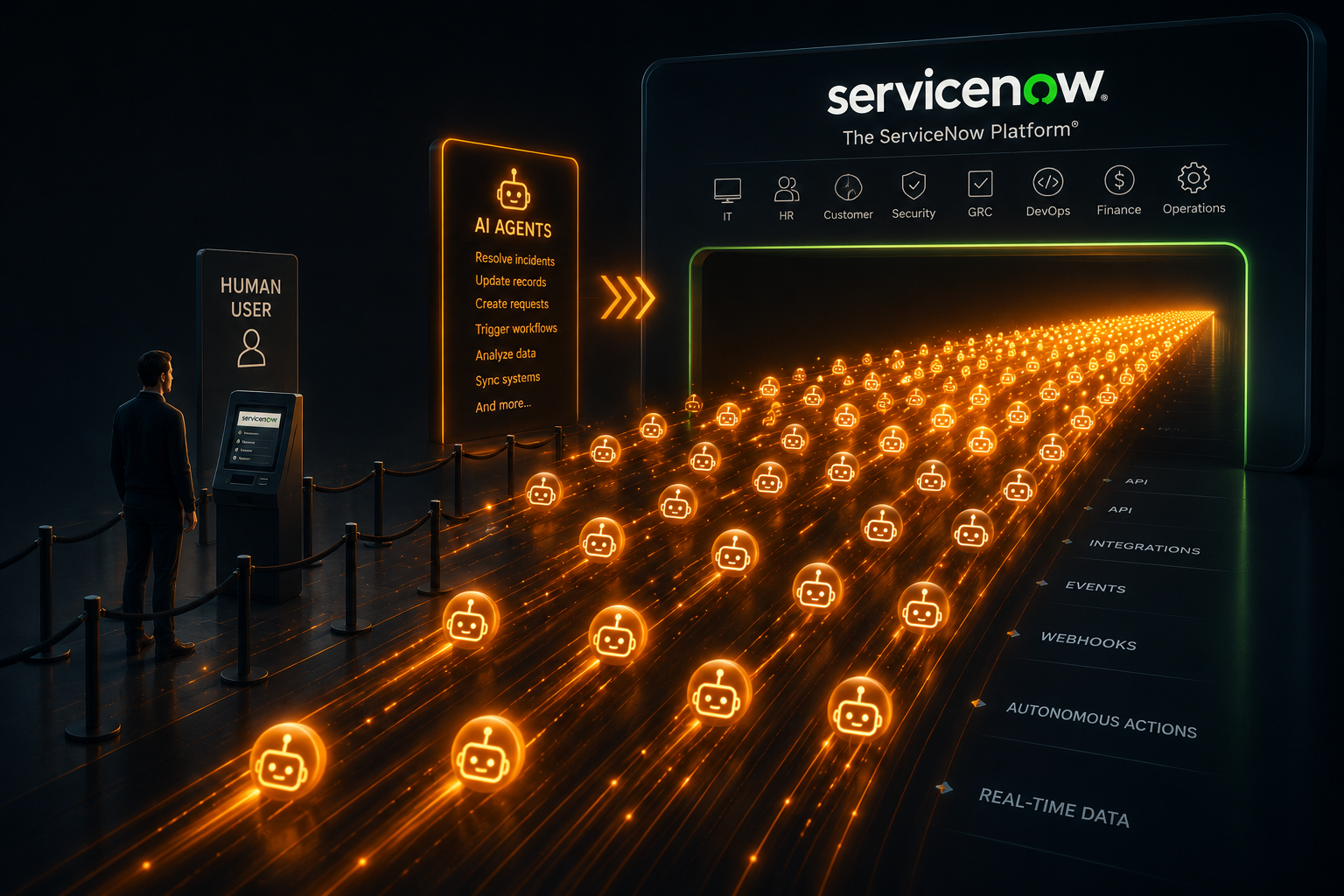
At Knowledge 2026, ServiceNow opened its full system of action to any AI agent, headlessly, through a generally available MCPServer. Twenty years of platform design assumed a human in front of a screen. The next user reads your platform instead of looking at it, and everything you built for eyes just became a contract read by machines.

01 – The moment
Picture an ordinary Tuesday. An employee is deep in a piece of analysis with her AI assistant, it could be Claude, Copilot, or an agent her company built itself, and she hits a wall: she has no access to the finance reporting system. She does not stop working. She tells the assistant to sort it out.
The assistant finds the right catalog item on the company’s ServiceNow MCPServer. It submits the request under her verified identity. The approval flow reaches the system owner, exactly as it was designed to. The audit trail is written, the fulfilment runs, and a few minutes later she has access. She never opened the ServiceNow portal. She may not even know ServiceNow was involved.
Everything the platform team spent years building, the catalog item, the approval chain, the fulfilment flow, the access policy, executed exactly as intended. Only one thing did not participate in the transaction: the interface.
“The workflow ran. The governance held. The interface was the only thing that stayed home.”
This is not a thought experiment. It is what ServiceNow switched on at Knowledge 2026 with Action Fabric, opening its full system of action, flows, playbooks, approvals, and catalogs, to any AI agent through a generally available Model Context Protocol (MCP) Server, included in every Now Assist and AI Native SKU. Access requests flowing from an external assistant into governed ServiceNow approvals is one of the first published scenarios of the launch partnership with Anthropic.
I think this is one of the most consequential platform decisions ServiceNow has made in years, and I mean that as a green light, not a warning. But it quietly changes what platform quality means, and that is the part I want to put in front of every platform owner.
02 – The shift
For twenty years, enterprise platform design has assumed a human in front of a screen. Portals, forms, catalog descriptions written for eyes, navigation that made sense if you knew where to look. We did not just build for people, we built for patient, adaptable people who compensated for every ambiguity. A confusing item name? They asked a colleague. Two catalog entries for the same thing? They recognized the right one from experience. The interface was where all that quiet human repair work happened.
That assumption is now optional. With Action Fabric, an agent connects to the platform’s logic directly, no portal, no form, no screen. ServiceNow calls this headless: the same governed system, reached through a different entry point. And the direction of travel is unmistakable when you look at 2026 as a whole. In July, ServiceNow began switching Now Assist defaults to third-party LLM providers, bringing outside models into the platform. With Action Fabric, it lets outside agents execute work from beyond the platform. ServiceNow is opening in both directions at once, models in, agents in, and positioning itself as the execution layer every AI experience runs through.
“You designed the platform for people who lookat it. Its next user reads it.”
This is the point worth sitting with. When the primary consumer of your platform stops being a person clicking through a portal and becomes an agent resolving intent against your catalog, nothing about the platform’s importance shrinks. What changes is which qualities matter. The qualities that mattered for eyes, layout, visual hierarchy, friendly labels, matter less. The qualities that matter for machines, precise naming, unambiguous structure, explicit logic, matter absolutely.
If that sounds familiar, it should. It is the same shift I have described for the service model: the reader changed, and the cost of ambiguity changed with it. That argument has now arrived at the action layer. First AI read your data model. Now it executes your action model.
03 – The precision
It is worth being precise, because this will be read by people who know the platform well. Action Fabric is ServiceNow’s framework for connecting AI agents across the enterprise, and it has three components. The MCP Server Console exposes ServiceNow capabilities as tools that external AI clients can discover and invoke. The MCP Client points the other way, giving ServiceNow’s own AI agents reach into external systems. And A2A, the Agent2Agent protocol, lets two agents collaborate on shared tasks as peers.
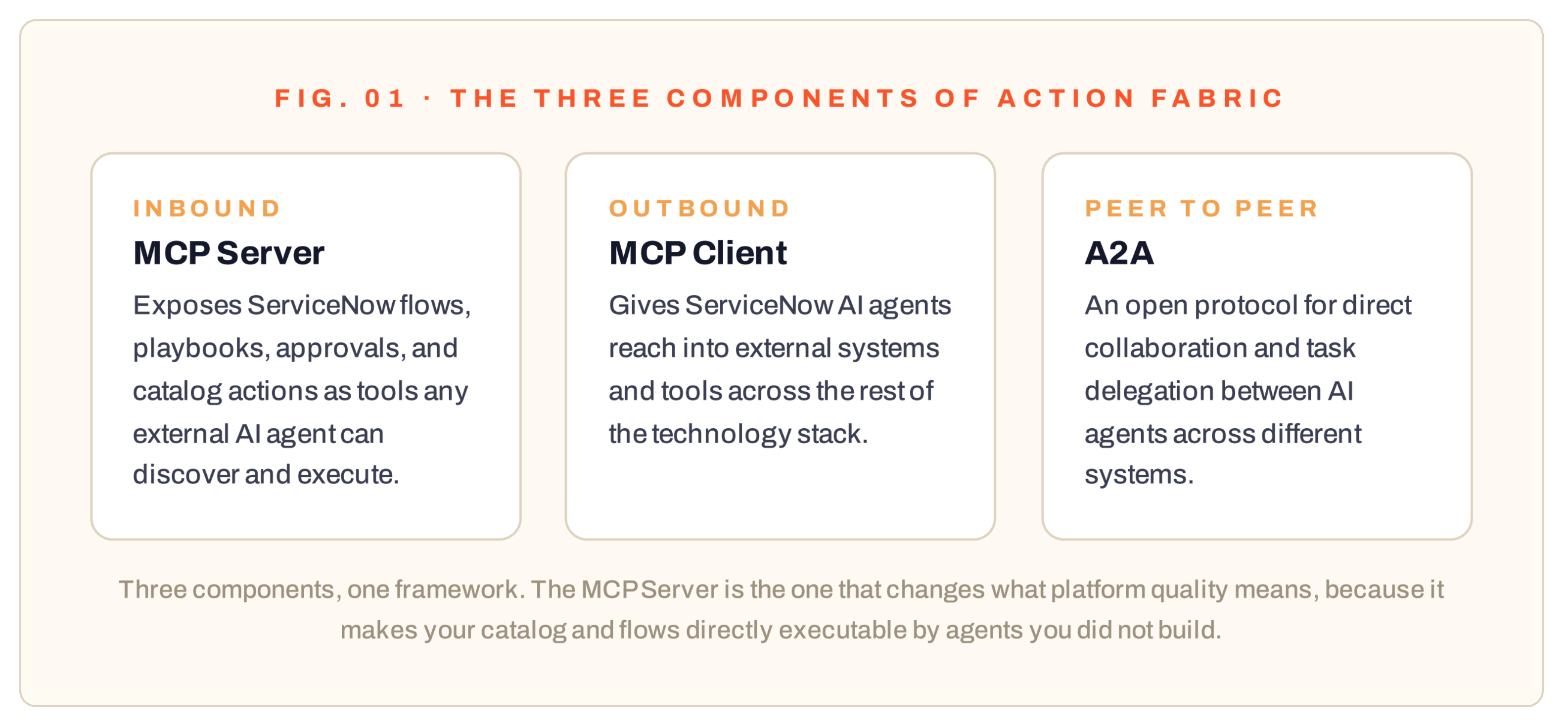
The difference from a traditional API integration matters. With REST, a developer hardcodes the exact endpoint and parameters at build time. With MCP, the agent sends natural-language intent, “request access to the finance reporting system for this user”, and the server resolves that intent to the right tool at runtime. The agent discovers what your platform can do dynamically, from a single connection.
And ServiceNow’s own framing of the differentiation is the sentence I would underline: other platforms let agents read and write data, ServiceNow lets agents execute governed work. Flows, playbooks, approvals, catalogs, the full system of action, with every call identity-verified, permission-scoped, and fully auditable through AI Control Tower. That distinction, data access versus governed execution, is the whole announcement in five words.
04 – The provocation
Here is the part I would put in front of every leadership team. When an agent resolves intent against your catalog at runtime, the quality of that resolution is only as good as your naming, your descriptions, and your structure. The catalog description is no longer help text for a human. It is the contract an agent reads before it acts.
Go back to the access request. A human employee looking for finance reporting access would survive a messy catalog. She would recognize that “FIN-RPT Access v2 (new)” is the right item and the older duplicate is dead, because a colleague told her once, or because she has been burned before. That knowledge lives in people, not in the platform. An agent has none of it. It reads the items as written, weighs the descriptions as written, and picks the best match on the model it can see, quickly, confidently, and at scale.
“Your catalog was written for people who could ask a colleague. Its next reader cannot.”
Every unclear item name, every duplicate entry, every approval chain that everyone “just knows”, these have always carried a cost, paid invisibly by patient humans a few minutes at a time. Headless, the same ambiguity produces a different outcome: a failed resolution, or a confidently wrong one. Not because the agent is careless, but because it is precise about whatever the platform actually says.
This is why I say platform quality is now agent quality. The catalog, the flows, the approval logic, and the data model beneath them have become one continuous machine-readable surface. The organizations that treated their catalog as a living product, clear names, honest descriptions, retired duplicates, are already agent-ready and may not know it. The ones that let the catalog grow like a shared drive will meet that debt the first week an external agent connects.
THE SAME ARGUMENT, ONE LAYER UP
I have argued before that your service model is what AI reads before it acts, and that a model your agents cannot read is a model they will act on anyway. Action Fabric extends that logic to the action layer. The service graph tells the agent what your business is. The catalog and flows tell it what your business can do.
05 – The green light
If opening the platform to every agent in the enterprise sounds reckless, the architecture says otherwise. Every headless action runs through AI Control Tower. Whether a password is reset by a person in the portal or by an agent through the MCPServer, the same identity verification, permission scope, and audit trail apply. Headless does not mean lawless. It means a different entry point into the same governed system.
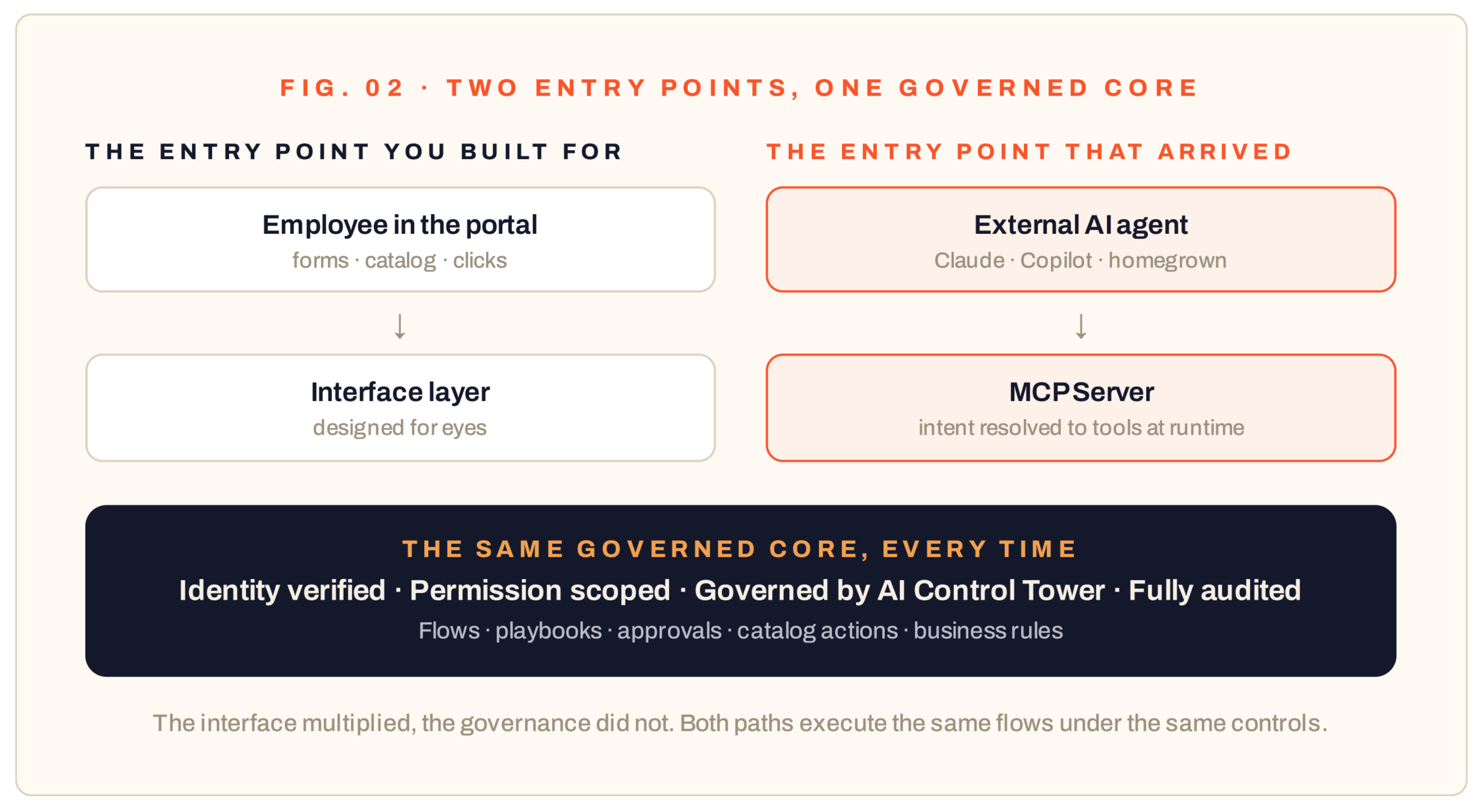
The controls are specific. The MCPServer Console ships with managed OAuth, session management, enterprise audit trails, and role-based tool packages, meaning you decide which actions each class of agent can even discover, let alone execute. Exposure is a decision you make action by action and role by role, not a switch you flip once for the whole platform. Governance, here as everywhere in this era, is not the brake on adoption. It is what makes adoption safe to accelerate.
WORTH ITS OWN CONVERSATION
AI Control Tower is quietly becoming the most strategically important product in the ServiceNow portfolio, the place where every agent, every model, and now every headless action is governed and measured. It deserves a full paper of its own, and it will get one.
06 – The meter
Headless work is metered work
One detail from the announcement deserves more attention than it has received. Headless actions consume the same Assist currency that Now Assist and ServiceNow’s own AI agents already use, one unified consumption model across everything AI does on the platform. Every external agent that executes work through the MCPServer is spending from the same pool as your human-facing AI.
That has a governance consequence: deciding which actions to expose is also an economic decision. An agent that retries a poorly described catalog item five times before resolving it is not just slow, it is spending. Catalog clarity, tool package design, and consumption now sit in the same conversation. I have written separately about what consumption-based AI pricing does to platform governance, and Action Fabric adds a new line to that bill: the work you did not watch anyone perform.
“Every conversation about which actions to expose is now also a conversation about spend.”
None of this is an argument against opening the platform. It is an argument for opening it the way you would delegate anything else that spends on your behalf: with a defined scope, a visible meter, and a review cadence. The consumption model is the same one you already govern for Now Assist. Headless execution simply adds a new category of consumer to it, one that works around the clock and never files an expense report.
07 – The playbook
Read your catalog the way an agent will. Open the items your organization uses most and ask one question: could a machine, with no tribal knowledge, resolve the right item from the name and description alone? Where the answer is no, that item is not agent-ready, and fixing it is cheap compared to what an ambiguous resolution costs at machine speed.
Decide the exposed surface deliberately. Use role-based tool packages to define which actions each class of agent can discover. Start where the underlying model is strong and the risk is contained, and let the exposed surface grow with the maturity of what sits beneath it. The pace of openness should follow the quality of the model, exactly as it should for autonomy itself.
Treat flows and approvals as contracts. An approval chain that depends on a human recognizing an edge case is not an approval chain an agent can safely trigger. Make the inputs unambiguous and the decision points explicit, and keep the human approvals that exist for judgment, not the ones that exist out of habit.
Watch the meter from day one. Consumption metering is built into the MCPServer Console. Baseline what headless execution costs before it scales, not after, and put agent-driven consumption on the same governance agenda as adoption and value.
“None of this is new work. It is the work you already knew mattered, with a deadline attached.”
08 – Final reflection
There is a longer game in this announcement, and ServiceNow’s leadership has been open about it. Every action executed through the platform leaves a trail: who requested it, who approved it, what it touched, how it was resolved. The more agents execute their work through the platform, the richer that operational record becomes, and the better grounded every next decision gets. Openness is not generosity. It is a strategy for becoming the place where enterprise context accumulates.
I have described the arc of enterprise software as record, then action, then context. Action Fabric is what it looks like when a vendor plays that arc deliberately: open the action layer to everyone, and let the context layer compound. The organizations that route their agents, all of their agents, through a governed execution layer will build a decision history their competitors simply do not have.
For platform owners, the assignment is clear, and it is encouraging rather than alarming. The platform you have spent years building did not lose its interface, it gained a second kind of user. That user is fast, literal, and tireless, and it will reward every hour you ever spent on clear naming, honest catalogs, and explicit logic. The work was never wasted. It was early.
“The interface was always optional. The governance never was.”
The organizations that win the next few years will not be the ones with the most beautiful portals. They will be the ones whose platforms read as clearly to machines as they ever did to people, and who opened their doors deliberately, action by action, with the governance already standing behind them.
Access the full brief as PDF by clicking here:

Your AI is already moving into the workflow. Is your governance keeping up? AI is quickly becoming part of how work gets done. In ServiceNow, it can...

If you’ve been anywhere near a ServiceNow release note, keynote, or LinkedIn feed lately, one thing is undeniable: AI is no longer “coming.” It’s...

More than a tool Many organizations already use ServiceNow successfully - whether to optimize IT processes, track incidents more efficiently, or...