
ServiceNow Has Outgrown IT Operations
ServiceNow has quietly become the AI platform for enterprise transformation. Most organizations still run it as a ticketing tool under IT...
 Odd M. Leonhardsen
•
6 min read
•
Odd M. Leonhardsen
•
6 min read
•

Enterprise systems began by storing the work. Then they began to run it. The era beginning now is about understanding it. The shift to a system of context is where the next advantage will be won, and it will not be won by whoever holds the most data.

Author's note
I have spent my career moving through three eras of enterprise software, though I only recognized the pattern recently. I did not plan it that way. It is simply the arc the industry has followed, and I happened to follow it with them.
In the early 2000s, in my IBM days, the work was the record. I spent those years across ITIL and ITSM, IT operations management, enterprise service and asset management, and even facilities management, back when the CMDB meant to tie them together was still largely a theoretical idea. What strikes me looking back is how separate those worlds were kept, and how much of the value was already sitting in the connections between them.
From 2014-2015, helping open ServiceNow's first office in Norway, and in the years since at The Cloud People, the work became the action: orchestrating it across the enterprise, not just storing it. And now, with agentic AI, it is becoming something else again. It is becoming the context.
That progression, from system of record, to system of action, to system of context, is the most useful lens I have found for where enterprise software is going, and where the next advantage will be won. This paper is my attempt to set it out plainly, and to say where I think ServiceNow fits in it.
01 – The pattern
In the first era, the prize was the record. Databases, ERP, the CMDB, the systems whose job was to hold the truth about what existed. The advantage went to whoever had the cleanest, most complete record, and the question that mattered was simple: is the data correct.
In the second, the prize moved to action. It was no longer enough to store the truth, you had to do something with it, route the work, approve it, orchestrate it across functions that did not talk to each other. ServiceNow built its business on exactly this shift, positioning itself, deliberately, not as a system of record but as a system of action. The question became: is the work getting done.
We are now entering a third era. Storing the data is assumed. Orchestrating the action is increasingly handled by agents. The scarce and decisive thing is context, understanding what the work means, who owns it, what it depends on, and what a decision will set in motion. The question is becoming: should this happen, and what follows if it does.
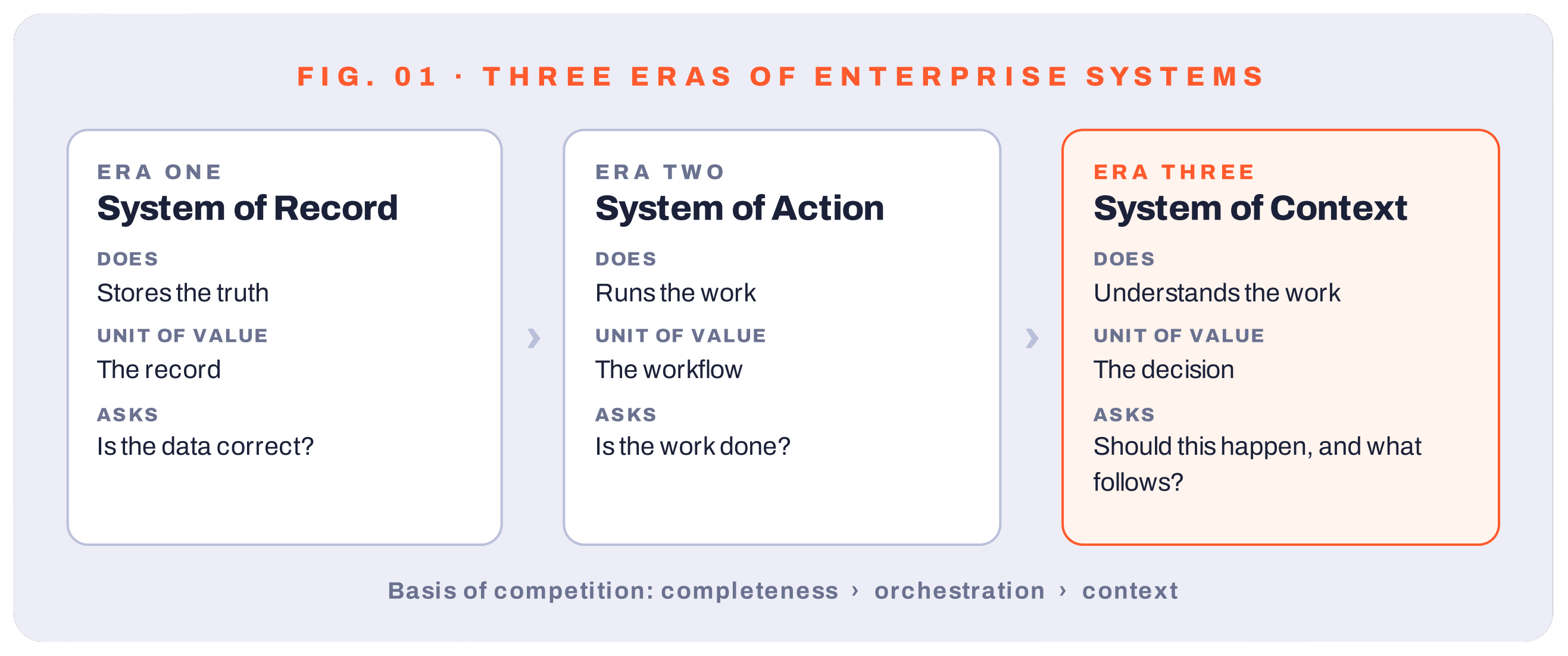
“Each era built on the one before. What kept moving up was where the advantage lived.”
02 – The hinge
It is worth dwelling on why action, on its own, is no longer enough, because that is the hinge of the whole argument.
A system of action is built to execute. Give it a defined process and it will run that process quickly, consistently, and at scale. That was a genuine breakthrough, and it is the foundation ServiceNow and others built on. But execution is not understanding. An action layer can run a flawless process and still do the wrong thing, because deciding what should happen, and grasping what it will affect, is a different capability from carrying it out.
For years, that gap was filled by people. A human sat between the system and the action, supplying the context the system did not hold: this service is more fragile than it looks, that owner needs to be consulted, this change should wait. The system acted, but a person decided. Agentic AI can now take that person out of the loop. In many cases it should not, some decisions still belong with a person. But wherever it does act on its own, the context that person was quietly supplying has to live somewhere a machine can read it.
“Execution is not understanding. A system of action can run a flawless process and still do the wrong thing.”
03 – The third era
So it is worth being precise about what context means. It is the layer of meaning around the work: which business service this touches, who owns it, where it belongs, what it depends on, what state it is in, and why the last several similar decisions went the way they did. Belonging matters more than it sounds, which country, legal entity, or team something applies to, so that an agent does not send a German travel policy to an employee in Finland, or handle a case under the wrong jurisdiction's rules. Some of this is already modelled, in the service graph, the workflow data, the decision history. Much of it is not. It lives as tribal knowledge, in the heads of the people who have run the place for years and know how things really connect.
A system of context is the layer that makes that meaning explicit and usable, by people and by agents alike. It is where decision intelligence happens, not just executing a workflow, but understanding it well enough to judge whether it should run at all, and what it will cost if it does. This is the capability the next era of enterprise software is organizing itself around, and it is the hardest of the three to build, because so much of the raw material has never been written down.
Done well, that same layer also marks its own boundaries. It tells you which decisions an agent can safely take on its own, and which should still go to a person. A human in the loop is not a failure of automation, in many cases it remains exactly the right design, and a strong context layer is what lets you draw that line deliberately, by risk and by case, instead of guessing at it.
That is also why it is valuable. A layer that is hard to build is a layer that is hard to copy.
“Most of your context has never been written down. It lives in the heads of the people who run the place.”
04 – The provocation
Here is the provocation I would leave with any leadership team. The next competition is not about who has the most data. That race is largely over. Data is abundant, and the models everyone is buying are trained on oceans of it. Data has become a commodity.
The next competition is about who owns the context around work, decisions, and consequence. That context is scarce, it is specific to your enterprise, and most of it has never been captured. It is the part that cannot be downloaded or trained on, because it exists only in your service model, your workflow history, and your people's heads.
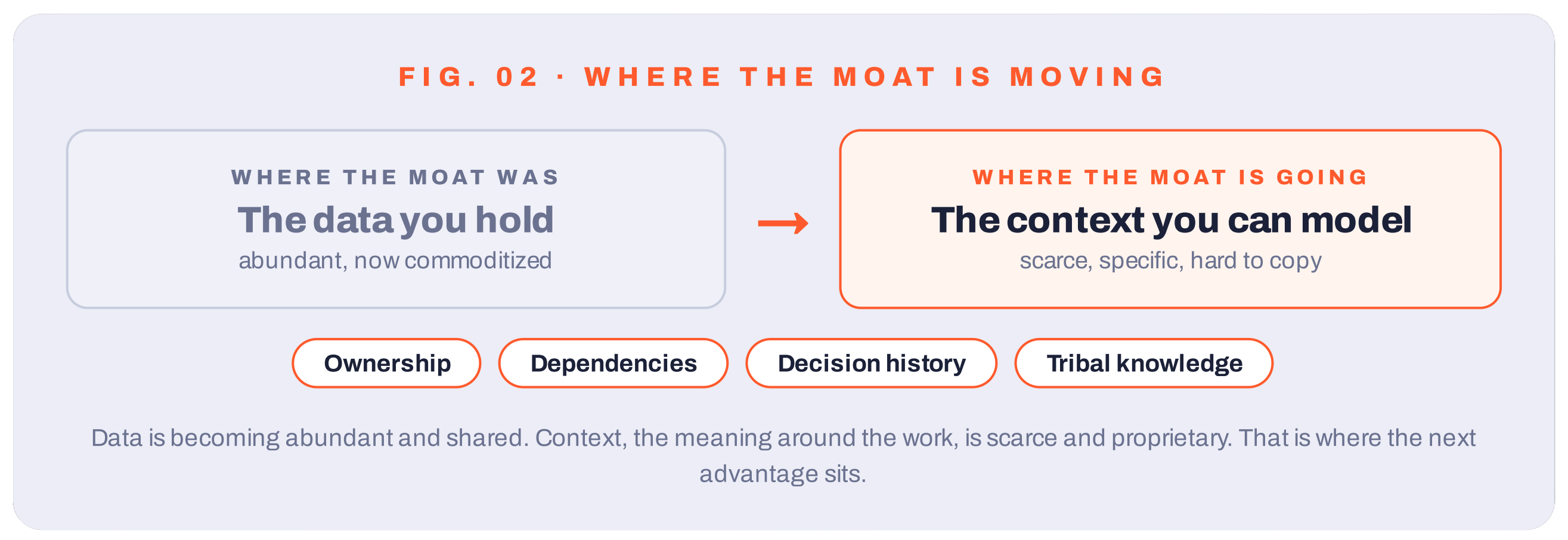
Whoever turns that context into something machines can act on, reliably and with governance, will hold the decisive layer. Not the most data. The most usable context.
05 – The operating layer
Where I think ServiceNow fits
This is where ServiceNow has a real claim, though not a guaranteed one, and it is worth being precise rather than promotional about it.
The system best placed to become the system of context is the one that already runs the action and already holds the surrounding data. ServiceNow sits in an unusual position here: it orchestrates work across IT, security, HR, finance, customer service, and more, and that work leaves a trail, ownership, dependencies, approvals, and decision history, which is the raw material of context. The company is building directly on this with its Context Engine, which it describes as drawing on the enormous volume of workflow data running through the platform, and with AI Control Tower as the place to govern what agents do with it. On the Knowledge 2026 stage, NVIDIA's Jensen Huang called ServiceNow the operating system of enterprise AI agents, which is another way of describing a bid for the context layer.
I want to be careful not to overstate it. This is a contest, not a coronation. Hyperscalers, data platforms, and other application vendors are reaching for the same layer, and even the analysts who like ServiceNow's position, such as Bank of America, frame its workflow entrenchment as an advantage rather than a certainty. But the logic is sound: the layer that already coordinates the work, and can govern the agents acting on it, starts closer to owning the context than a layer that only stores data. That is the central role I believe ServiceNow can earn, if it executes.
“The layer that already runs the work starts closest to understanding it.”
06 – Final reflection
I find this framing clarifying because it explains so much of what is happening at once. The scramble to govern AI agents, the sudden urgency around the service model, the race to connect workflow data, all of it is really one move: the contest to own the context around enterprise work.
Each era did not replace the one before, it built on it.You still need the record.You still need the action. But the advantage, and the value, is moving to the layer that understands the work, not just the layer that stores it or runs it. The organizations and the platforms that grasp this early will spend the next decade deciding better, and faster, than the ones still optimizing the layers below.
That is the bet I would make, and the lens I would use to read every announcement, every acquisition, and every roadmap from here.
“The next advantage is not the data you store or the work you run. It is the context you understand.”
Access the full brief as PDF by clicking here:
 THE PERSPECTIVE SERIES
This is a part of an ongoing series from The Cloud People on ServiceNow, enterprise platforms, and AI-driven transformation. More to follow.

ServiceNow has quietly become the AI platform for enterprise transformation. Most organizations still run it as a ticketing tool under IT...

For years, CSDM lived inside the CMDB conversation, and it was treated the way good infrastructure usually is: clearly important, easy to agree...

Elisa has been investing in the ServiceNow platform and related AI solutions for years, both in its own operations and in the services it delivers to...